Showing posts with label rhetoric. Show all posts

Monday, March 9, 2015

Week 7 — Project 2 — final deliverables & AIGA poster

Due:
  • Thoughtful verbal/visual presentation of Parts A, B, C. 7 minutes max.
  • Print work, consistently, in color, on 8.5x11 or 11x17 pages. Pin-up for critique, before start of class.
  • Post to blogs for evaluation.


Studio:
AIGA Social Advocacy poster
  • The AIGA invites designers to create social advocacy posters
  • To get started, download the design brief and poster template and video credit screen.
  • Evolve your initial design concepts – that utilizes rhetoric and modes of appeal — from phase B.
  • Due for class crit: 3/10. Print 1 or more poster design(s), full scale, full color, in template.
    • Posters should be 11 x 17 inches (portrait).
    • 0.125 inch bleed
    • All images and art are RGB.
    • All images are 300 dpi at full-size.
    • The credit band has been updated with your personal information.
    • If applicable, Interstate bold was replaced with either Univers 65 or Helvetica bold.
    • All type has been converted to outline.
    • Save as a press quality PDF. Please do not add security restrictions to your PDF. 
  • Deadline for submissions will be May 16th. Submit online.
  • Any poster that incorporates positive social impact with global, national, or local content can be submitted (Feel free to narrow this down for your class if necessary).
  • Entries that use a specific organization's logo will be disqualified. 
  • Submissions will be displayed based on creativity and effectiveness in considering environmental, economic, social and cultural issues. 
  • All students can enter regardless of AIGA membership. 
  • AIGA is responsible for all final printing.


Homework:

Please post your self reflection:
  • how do you think you are doing over all?
  • where do you think you are struggling? succeeding?
  • how do you think you will address the areas that you are struggling with? 
  • what are your goals for the rest of the semester? 

Wednesday, March 4, 2015

Week 6 — Project 2: Rhetoric

On Friday, everyone will meet in Irving Auditorium at 8-8:30am for a mandatory graphic design department meeting 

Due:
  • Review your printed pieces. Take careful notes for later revisions.

Studio/homework:
Part A: Identifying Rhetoric (modes & tropes)
  • 3 modes x 3 found examples per mode = 9 total
  • 1 found example per trope = 9 total
Each example will be:
  • considered and well-crafted documentation of found artifacts
  • clear and consistent labeling, descriptions and citations
  • thoughtful and consistent composition of elements (type and image)

Part B: Rhetorical Combos (persuasive matrix & sketches)
methods:
  • produce studies of your chosen topic that successfully employ the theory
  • execute 3 out of 9 tropes, one from each mode = 3 total (one example each of ethos, pathos & logos, different trope for each)
  • studies are well-crafted and formally engaging
  • studies are communicative and insightful
  • clear/correct labeling
Plus, include clear and selective documentation of analog sign-mapping and matrix.

Part C: Defining Rhetoric
methods:
  • clear/correct and concise definitions for each term, in your own words (14 total)
  • rhetoric, metonymy, synecdoche, antithesis, pun, hyperbole, metaphor, personification, irony, parody
  • modes of appeal, pathos, logos, ethos
  • well written, concise and insightful reflection on what you learned about rhetoric and its application to graphic design practice (1-2 paragraphs)
  • thoughtfully typeset the above definitions and statement. Must be a new/different approach from project 1.

Homework:
  • Prepare a thoughtful verbal/visual presentation of Parts A, B, C (see above). 7 minutes max.
  • Have your keynote ready, before start of class.
  • Post to blogs for evaluation.
Kim Huynh:


Monday, March 2, 2015

Week 6 — Project 2b: Rhetorical combos

Due:
  • Review matrix

Studio:
  • Shift concepts into the three appeals (i.e. either they already are or have the potential to be that appeal).

Homework:
  • Based on critique/feedback, select 3 sketches to refine. 
    • Tool: Digital. 
    • Total 3.
  • Each direction should appeal to a different mode. (ethos, pathos or logos)
  • Center consistently on 8.5 x 11. Print for review.

Wednesday, February 25, 2015

Week 5 — Project 2b: Rhetorical combos

Due:
  • Review examples
Studio:
Sign-mapping brainstorming: 
ideate > research > edit > label > document
Collaboratively brainstorm various signs for one of the following topics.
  • censorship
  • racism / police brutality
  • early childhood education/ literacy or arts
  • legalization of marijuana
Break into groups (by topic) and begin by brainstorming. Tools: analog methods, large work space, color markers, stickies, etc.
  1. Ideate: Brainstorm in a group
    1. State the topic – be as specific as possible break the topic to make the session more productive
    2. Write/sketch everything, there are no wrong answers — using a large sheet of paper, pin it to the wall and begin to write everything down. Get the obvious ideas out, to make room for the more complex ideas.
  2. Research: Conduct some quick secondary research for get more ideas
  3. Edit: As you work, properly identify the 3 classifications – icons (exact representation), indexes (relatable connection without direct replication) and symbols (learned). 
  4. Label: Indicate the preferred method of signification (word or image). 
  5. Document: When finished, carefully document outcome.

Homework:
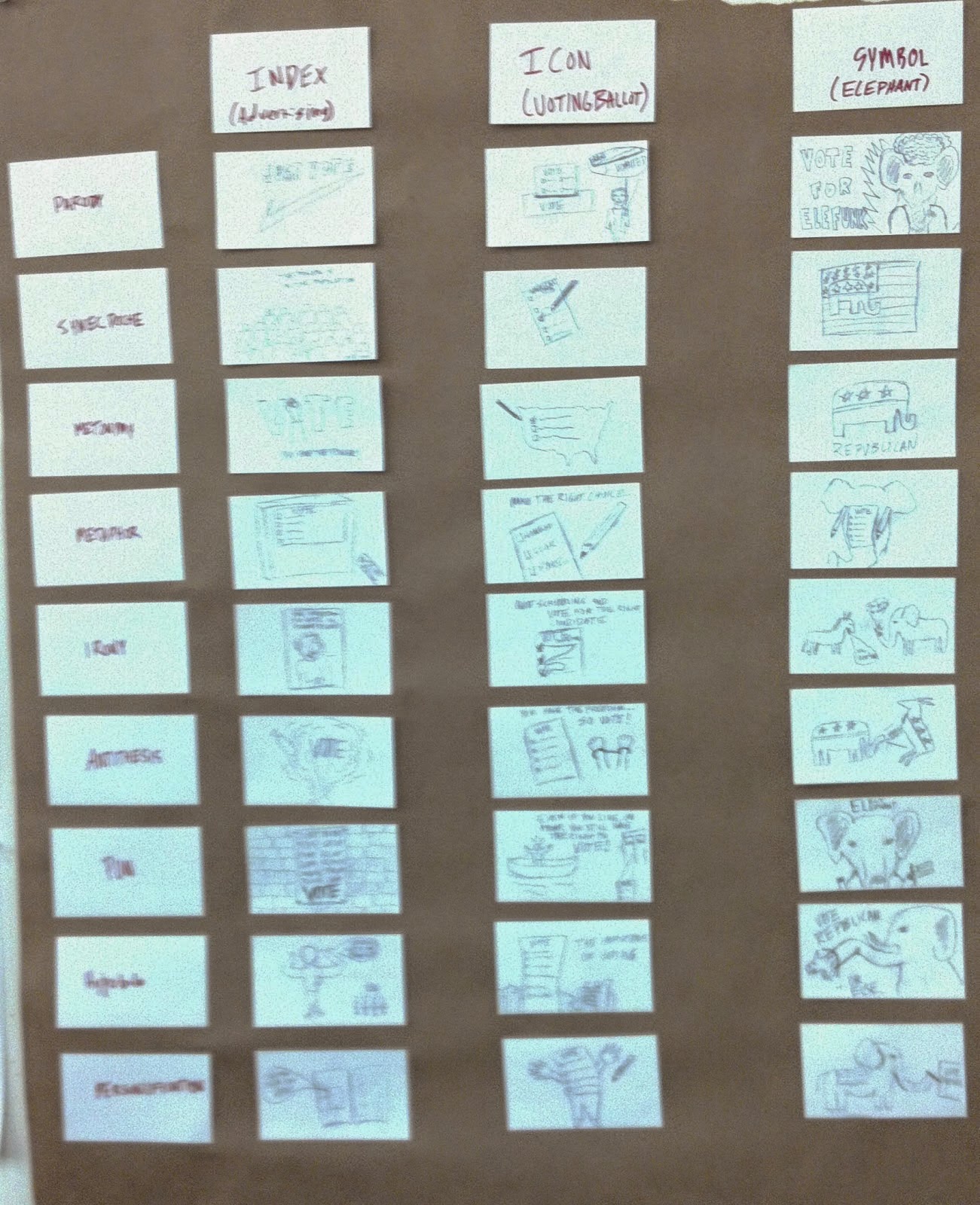
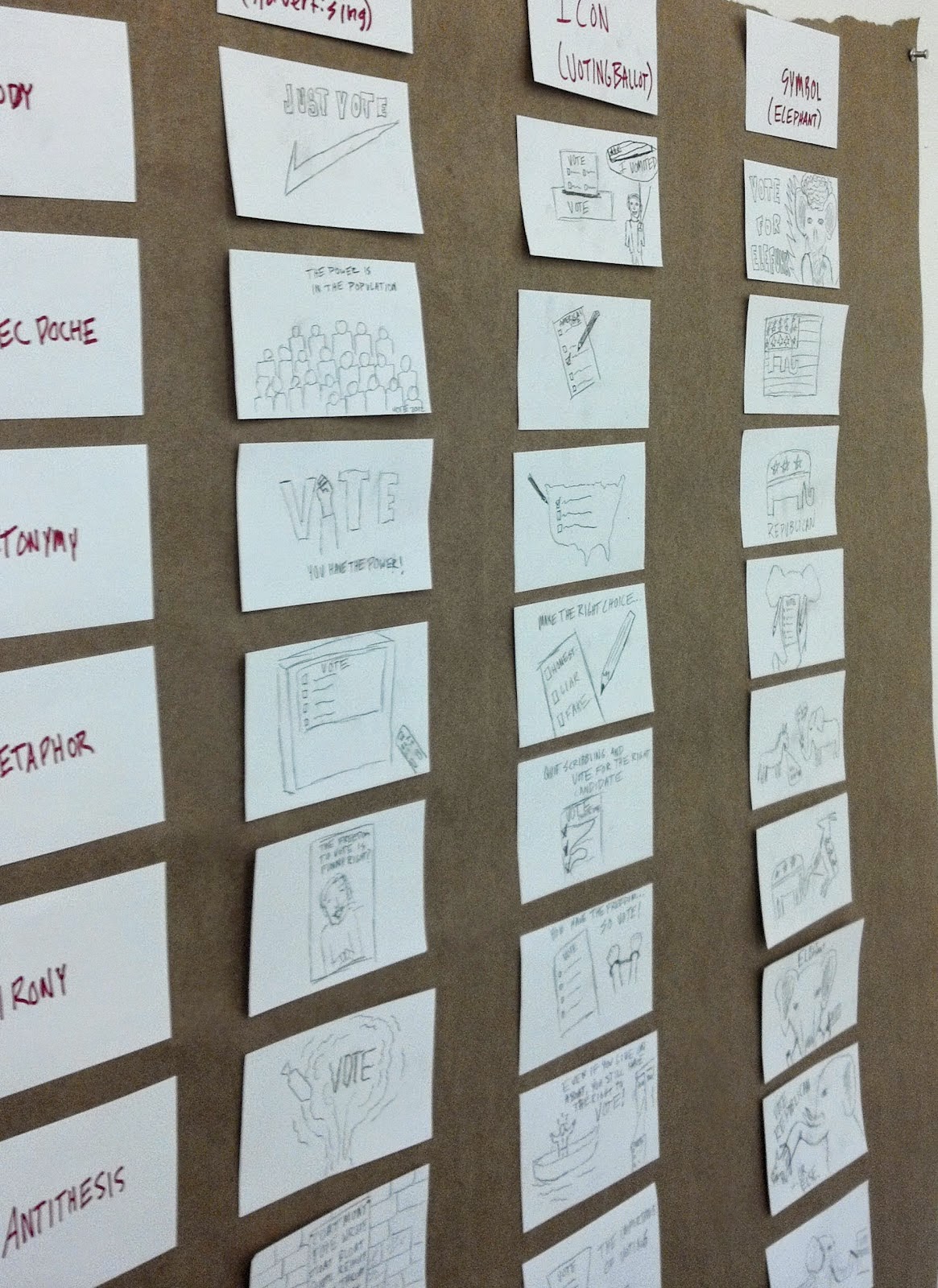
Rhetorical Combos (create individually)
  1. From the brainstorm session, select 1 icon, 1 index and 1 symbol to work with. Minimum 3, but you may use more.
  2. Create a matrix in which to iterate various clever, insightful and communicative combination that persuade people to support your social cause. Solutions may range from more illustrative to more typographic to more logo-like.
    • Tools: large segment of craft paper, marker, sticky notes or index card/tape, pencil.
    • (1 trope per row x 9 rows) + (1 column per sign x 3 signs) = 27 total. (approx 5 min. per sketch)
    • Fit each sketch on sticky note or index card, neatly labeled with respective trope. Arrange cards on matrix.

Anna De Sando:


Sam Small:


Monday, February 23, 2015

Week 5 — Project 2b: Defining rhetoric

Due:
  • Reflect: Post 1-paragraph crit of the museum as design experience/design artifact.
  • Read/watch and record notes and thoughts to your blog.
Studio:
  • Review examples of modes
  • Find and post examples of tropes (in class)
  • Lecture: Tropes
Homework:
Tropes
  • Select 3 of the trope examples and explore different compositional and typographic approaches for display. 
  • For each label the trope, critique how/to what effect it is employed (for audience/context/content), and credit the source.

Modes
  • Thoughtfully compose and label each “set” of visual examples in a considered arrangement. For each organize and label by mode and graphic component, include explanation of your selection as it applies to theory, and credit the source. 
  • Reflect: Post 1-paragraph crit of the museum as design experience/design artifact.
  • Read/watch and record notes and thoughts to your blog.
  • Find & define one or more examples for the following tropes (9) 
    • Don’t forget the design artifacts list, design books and WW1 Museum (look at graphic artifacts and exhibition design. 
    • Print/bring examples to class:
      • rhetoric (definition only)
      • antithesis
      • hyperbole
      • irony
      • metaphor
      • metonymy
      • parody
      • personification
      • pun
      • synedoche
  • Bring examples from graphic tool-kit for review.
Kim Huynh:
personification

synecdoche

hyperbole

hyperbole

irony

irony

parody

metaphor

metonomy

pun


synecdoche
For each:
  • Examples: improve selection, as needed
  • Descriptions: must be well-written and exemplify your understanding of theory
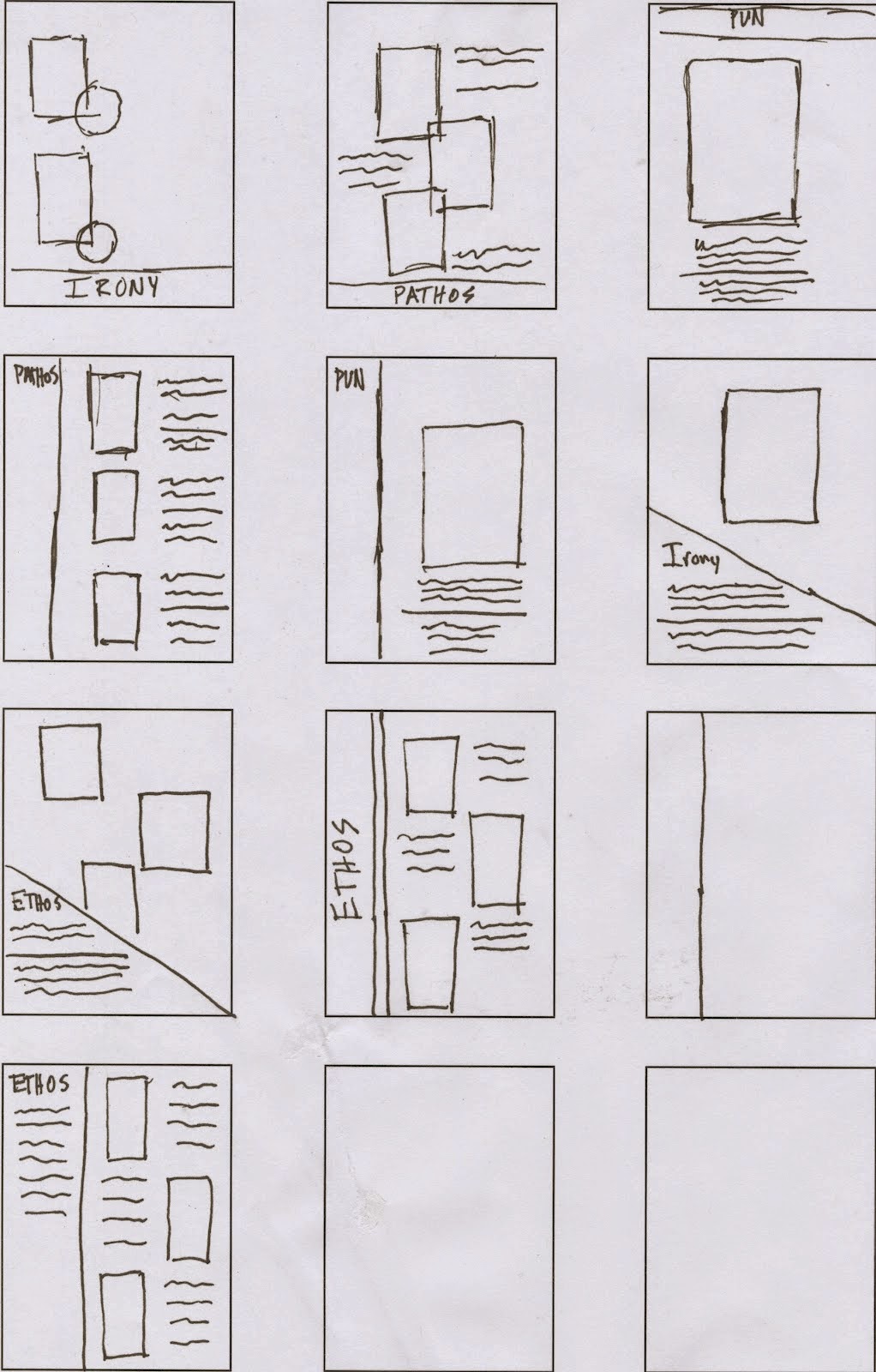
  • Composition: approaches must be different from each other and from Project 1. (You will apply the final design style to the remaining tropes later.) Start with thumbs (post to blogs). Execute digitally. 
  • Print on 8.5x11 or 11x17 pages. 3 tropes + 3 mode sets = 6 iterations total.
Sam Small:

rough sketches

modes - layout option 1

modes - layout option 2

modes - layout option 3

tropes - layout 1

tropes - layout 2

tropes - layout 3

Kim Huynh:

The "Cocktail" Poster is by Michael Schwab Studio (www.michaelschwab.com). Found in the Poster Annual Book, 2010 (pg 65).


Wednesday, February 18, 2015

Week 4 — Project 2a: Identifying rhetoric & visit to the WWI Museum

Due:
  • Examples of modes of persuasion (ethos, pathos & logos)

Field trip to the WWI Museum 12:30—2:00
100 W. 26th Street
Kansas City, MO 64108 
(816) 888.8100

Homework:
  • Browse/read Second Story’s website case study of the exhibition design.
  • Reflect: Post 1-paragraph crit of the museum as design experience/design artifact.
  • Read/watch and record notes and thoughts to your blog.
  • Find & define one or more examples for the following tropes (9) 
    • Don’t forget the design artifacts list, design books and WW1 Museum (look at graphic artifacts and exhibition design. 
    • Print/bring examples to class:
      • rhetoric (definition only)
      • antithesis
      • hyperbole
      • irony
      • metaphor
      • metonymy
      • parody
      • personification
      • pun
      • synedoche
  • Bring examples from graphic tool-kit for review.
Kim Huynh:
personification

synecdoche

hyperbole

hyperbole

irony

irony

parody

metaphor

metonomy

pun

synecdoche